Having relocated to NYC last year, I’ve started to really get interested in American sports and their culture. The dedication and desire for excellence are absolute, and one particular role is always standing out for me: the head coach.
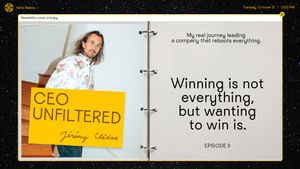
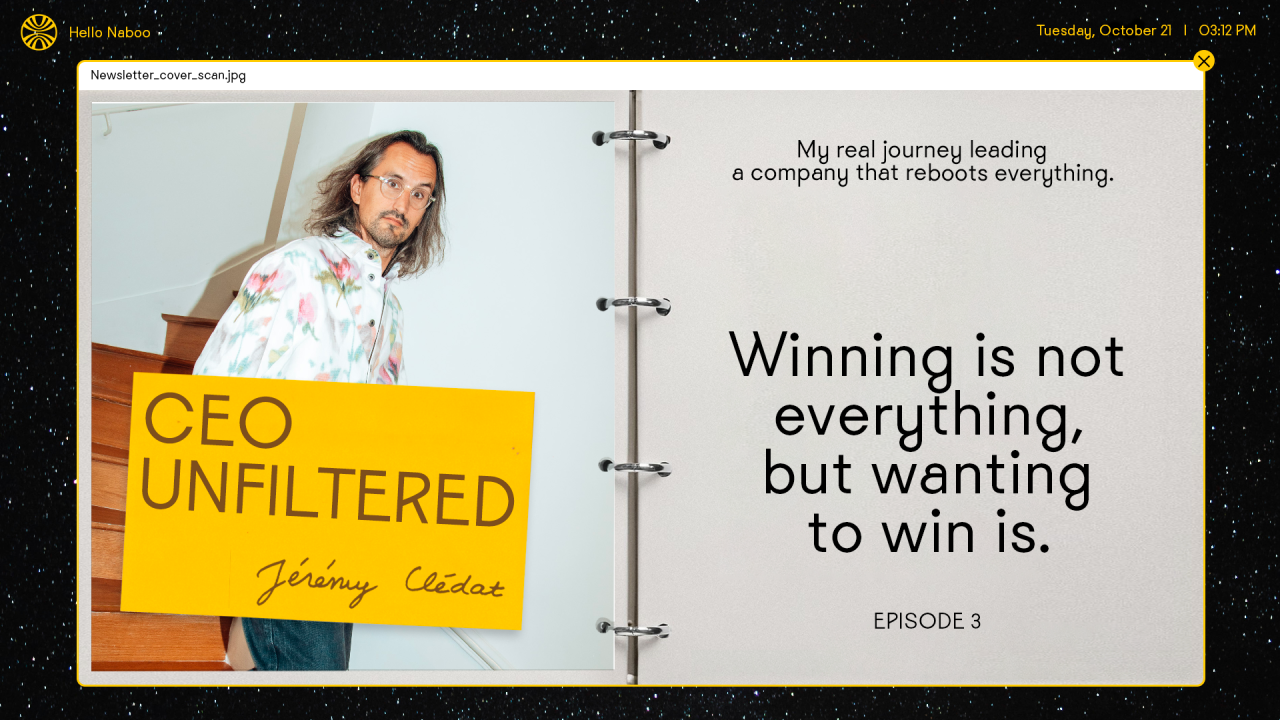
I recently learnt more about Vince Lombardi, considered one of the best and most successful coaches in NFL history. I got stuck with his most famous quote: “Winning is not everything, but wanting to win is”. It hit me as I understood it perfectly encapsulates why some companies are struggling and how, even if you have all you need to win, you get stuck in a losing momentum.
Winning is not everything, it’s the only thing. That’s what I believe to be true today. As a company, you start deteriorating as soon as you forget that your goal is to win. A company is not meant to optimize processes, get the best org chart, achieve some KPIs. And certainly not “avoid losing”. It should be built to win.
Looking at our last 3 years, I’m starting to think that at Welcome to the Jungle, we’ve been playing not to lose. Which is a fundamentally different game than playing to win. So this is the change we need to make. And when you’re talking about culture change, and the necessity of it, this is the priority that you need to get right immediately.

“Let’s make no mistakes”
Going back to Welcome to the Jungle. A few years ago, when we were growing more than 100% per year and raising capital, we started hiring more people which brought processes, frameworks, and best practices. It felt important. We needed structure.
But we didn’t see what could come with it. Bureaucracy started to knock on the door, and very quickly the mindset shifted. We went from "How do we build something extraordinary?" to "How do we not mess this up?". Success needs to generate more success, and the idea of failure becomes more and more unacceptable. But failure is part of every startup story. So you inevitably start failing, you get stressed by it and you build firewalls and 10 steps plans to avoid failing again. Risk mitigation becomes a priority. Winning not that much.
What was a strength can easily become a weakness. At Welcome to the Jungle, we've always believed in doing things well. I mean, really well. That has been part of our DNA since day one, and it allowed us to bring great products to the world and deliver a standout, meaningful brand. But at some point, "doing things well" became a dogma. An excuse for excessive caution.
We started working on products that were never delivered on time. Every time we thought we were ready to move, someone would raise a concern: "But what if this or that happens?" And we'd lose another three weeks analyzing a scenario that might never occur. Obscure edge cases become life threatening topics. And meetings multiply.
The irony of it? You become so focused on not failing that it makes failure almost guaranteed. You go from winning to inertia, and then from inertia to survival mode. You make small bets because big ones are scary. You optimize for marginal gains. You launch products designed not to lose money rather than to dominate markets. And when everyone around you is playing offense, playing defense is a losing strategy.

Here comes culture change
When things are not working properly, the classic reaction is always the same. We don’t have the right culture anymore, and we need to change it. As a leader, this is the hardest thing you’ll ever have to do.
You can only truly understand your company’s culture in retrospect. You never really know what your culture is at one specific moment in time. Six months or a year after a shift happens, you suddenly look back and think, "Oh, so that's when things changed." But at the moment? It's nearly impossible to see it happening.
That makes culture change incredibly difficult. It's multi-factorial. It depends on external forces you can't control. It depends on whether people actually want to change, and you can't force that. Changing culture is like trying to rewrite your company's DNA. It's not natural. It's not something you can decide during a company’s All Hands.
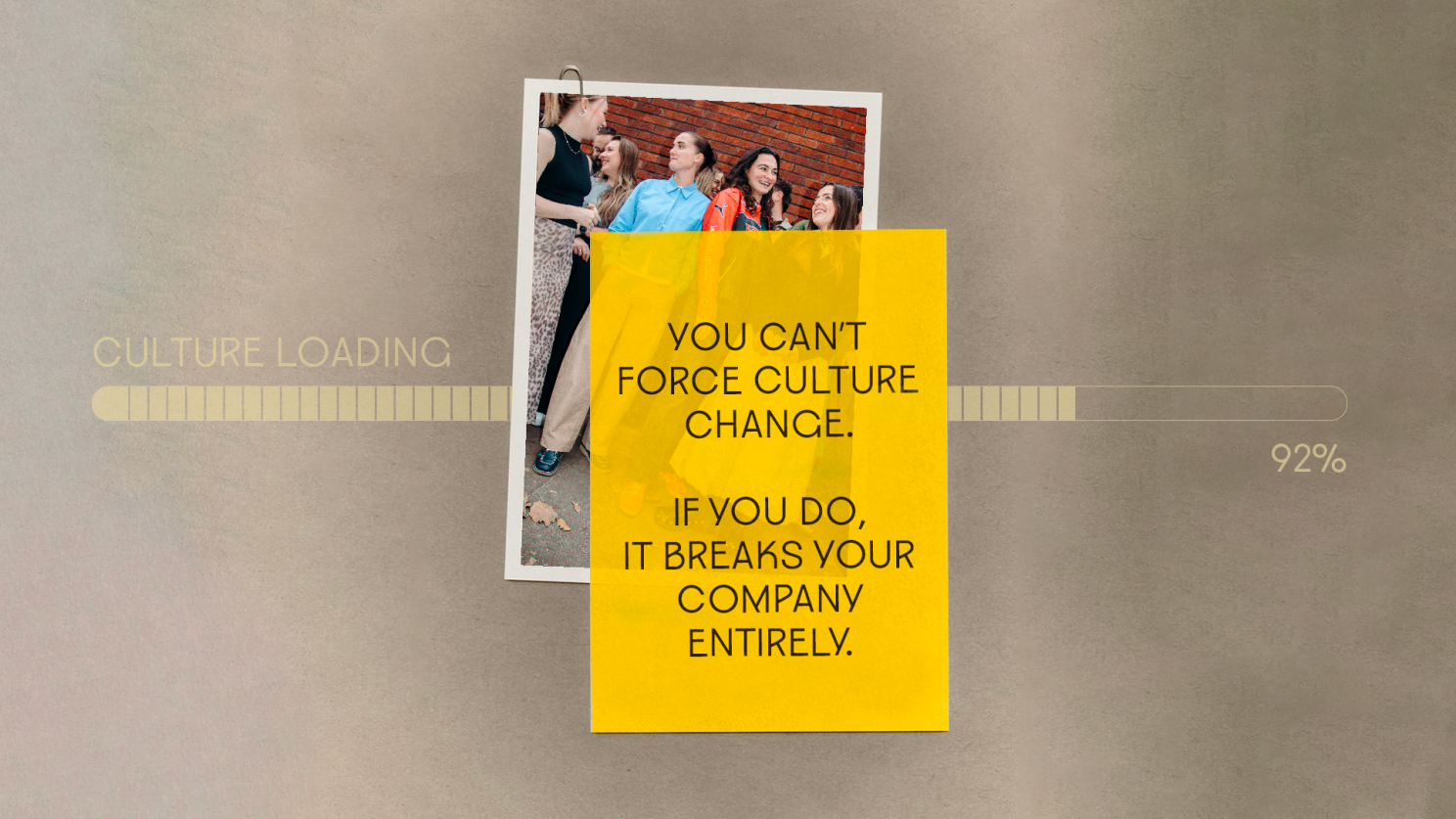
I spent a lot of time thinking about this, looking for the right way to do this. Contrary to buzzy management books and countless advisors, there's no playbook. Every company is different. You can’t force culture change. If you do, it breaks your company entirely.
Culture is not a framework
Culture change has become a buzzword. Every company talks about it. Every consultant has a framework for it. Every board member has opinions about it.
"We need a culture of innovation”. Okay, and then what? "We need to drive performance".Sure, but how? "We need to be more agile".

Great, but you still have humans working here, not robots.
The problem is that culture change has been packaged into something neat and digestible. Something that looks good in a presentation. Something that can be solved with the right set of KPIs and initiatives. But that's not how it works. Because at the end of the day, culture isn't about processes or frameworks or metrics. Culture is about people. And people are complicated.
You need to find what actually drives people. What makes someone care enough to do the extra work? What makes a person take their work from good to exceptional?
It's not a single thing. Is it compensation? Maybe, but probably not the only driver. Is it working conditions? Partly. Is it their boss? Yes. Is it their teammates? Absolutely. Is it ambition? Definitely. Is it alignment with the mission? Critical. Is it balance? Essential.
But here's the part that rarely gets said out loud. If I'm going to give everything to this company, if I'm going to push myself, if I'm going to care deeply about the work, then this has to be positive for me too. That's not selfish. That's not unreasonable. That's just normal. We should all want to win.
And yes, we all want to keep our jobs. That's the baseline. But there's so much more to it. We want to feel like my efforts are valued. We want to grow. We want to feel like we’re part of something meaningful. We want to feel like our contribution matters. We want to feel respected and heard. We want to be on the winning team.
Culture change is about winning (again)
Six months ago, we did the reset of almost everything at Welcome to the Jungle. I knew it was needed. But I didn’t know about Vince Lombardi and his quote at the time. So I talked about culture change, and we shared initiatives, goals and KPIs to reach.
I should have talked about our desire to win. Do we want to win? How can we stop focusing on “not losing”, and really start to think about how to win? I’m sharing those thoughts at the same time this article is getting published. This is real time.
It’s clear to me that this is the only question you need to answer as a company. We are launching a lot of new products in the coming months, and this will help us go from “How do we build products as good as our competitors” to “How can we dominate the market”. The first question leads to mediocre products, the second to market leadership. But that can happen only if you truly believe you can win.
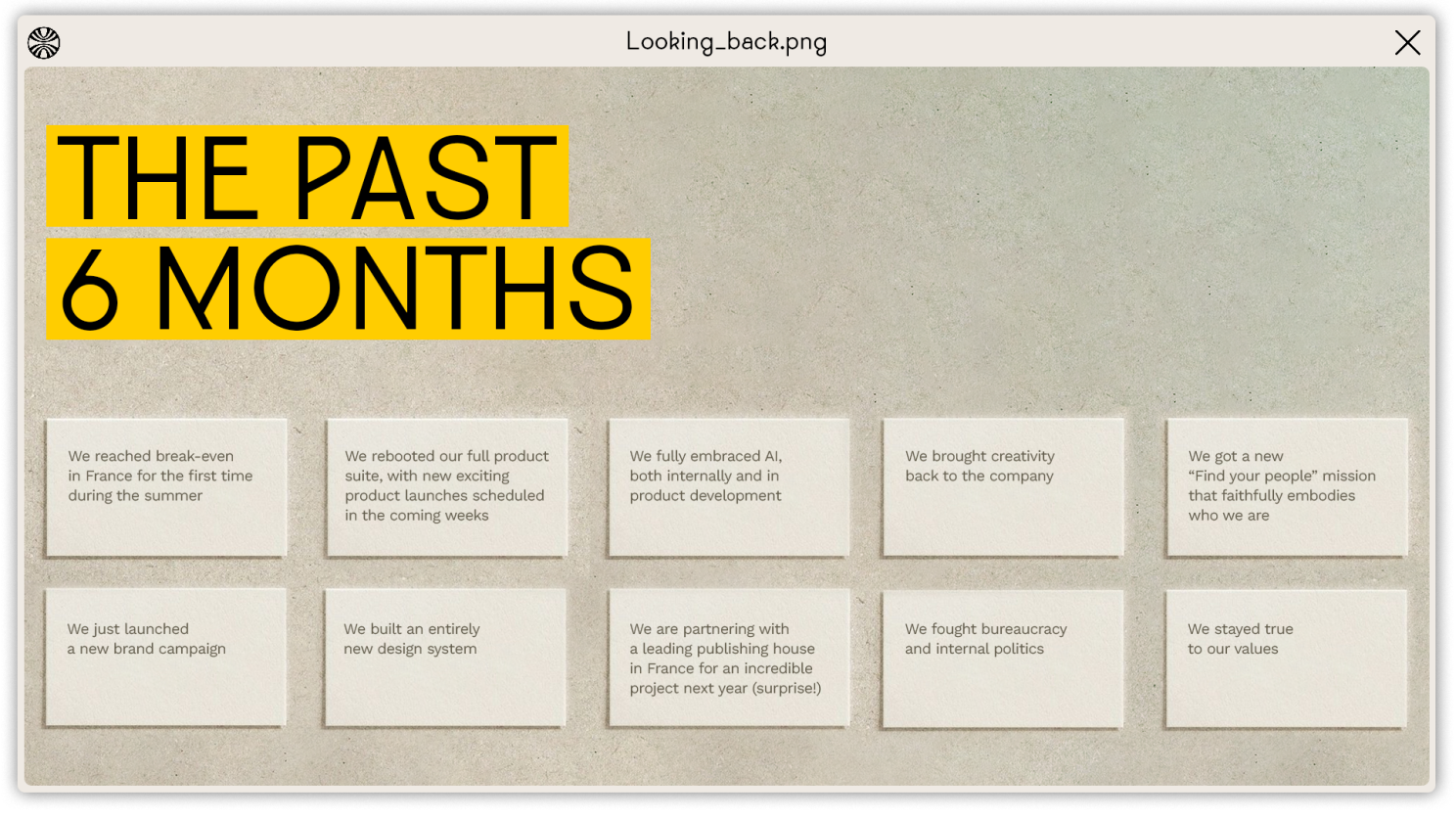
So to the teams at Welcome to the Jungle, this is the opportunity to remind you of everything we’ve done in those last 6 months:
We changed the whole leadership, allowed internal talents to grow and brought new amazing people in
We reached break-even in France for the first time during the summer
We rebooted our full product suite, with new exciting product launches scheduled in the coming weeks
We fully embraced AI, both internally and in product development
We brought creativity back to the company
We got a new “Find your people” mission that faithfully embodies who we are
We just launched a new brand campaign
We built an entirely new design system
We are partnering with a leading publishing house in France for an incredible project next year (surprise!)
We fought bureaucracy and internal politics
We stayed true to our values
The winning question is not “can we do it”. The question is “do we believe we can do it?”.
This is what culture change should be all about.