Friends: 4 scenes that show the rocky manager-employee relationship
Sep 07, 2021
9 mins


Journaliste - Welcome to the Jungle
Ever wondered how TV’s favorite besties were able to spend so much time hanging out at Central Perk? Particularly when they all needed day jobs to pay for those endless coffees! That’s why so many memorable scenes took place in their respective workplaces. And, in true sitcom style, things didn’t always go smoothly for them in the professional sphere. In one way or another, they all faced the tumultuous relationship that often exists between managers and employees. In a show that’s all about friendship, it begs the question: can managers and employees ever be friends?
To mark the Friends reunion, and for all the hardcore fans out there, we looked at four epic scenes with Laetitia Vitaud, an expert from The Lab by Welcome to the Jungle who’s also an author and speaker on the future of work. And whether you’re a manager or an employee, we hope you’ll come away with a better understanding of this often complex dynamic.
The one who tries too hard
Recap
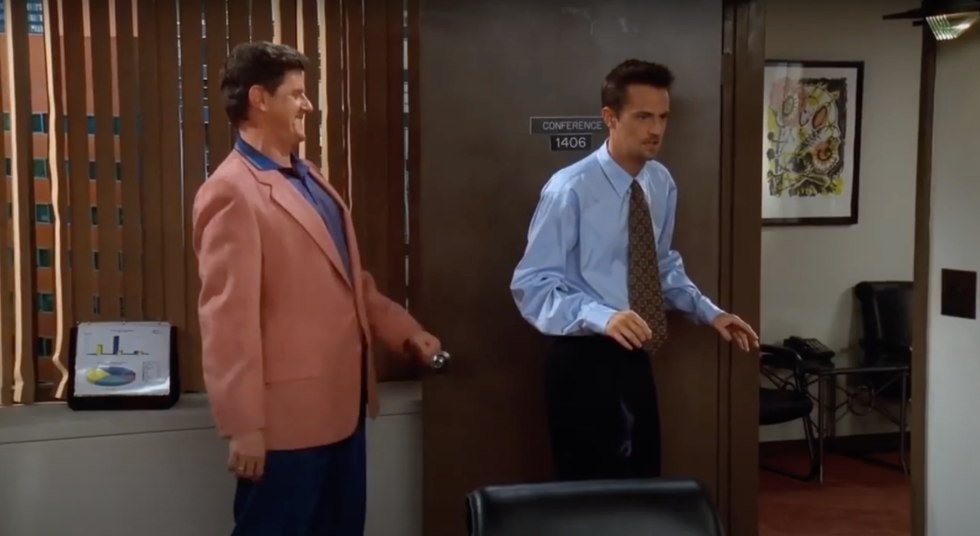
In season 1, episode 22, Chandler hires Phoebe as his assistant. That means he’s her manager, but his actual role remained a mystery until the reunion (in case you missed it, he’s a statistical analyst by trade). Phoebe has no problems fitting in. She soon tells him that the other team members hate him and his authoritarian ways, particularly his unpopular refrain: “Listen, about the weekly numbers—I’m gonna need them on my desk by nine o’clock.” Chandler is stunned and, in desperation, tries to make over his image—which only makes things worse. After crashing his superior’s karaoke party, Chandler fails to convince others he is cool with his rendition of Ebony and Ivory, and officially becomes the world’s most embarrassing boss. But before he was promoted to manager, these same people liked him. Together, they even mocked his predecessor. So, does taking on more responsibility automatically put us in the no-friends zone?
Expert analysis
It all boils down to the way your company is structured. A vertical or top-down structure such as Chandler’s office, for example, is less conducive to bonding with colleagues. “Friendly working environments need a horizontal or flattened structure, which is possible,” says Vitaud. “That said, some businesses claim to be horizontal when they are pyramid-shaped, and each employee must be careful about what they say and to whom they say it. Only those businesses that are truly horizontal allow more room for friendships to form. This is very common in Scandinavian countries, where employees have a great deal of autonomy and the means to succeed in their own projects. As a result, they are never ‘policed’ because the power dynamics within the hierarchy are greatly reduced.” In other words, Chandler should have moved to Norway. But that’s not the option he chooses—and it probably wouldn’t have been so hilarious.
The moral of the story
By the end of this episode, Chandler doesn’t know what to do. When he asserts his authority, he comes across as “bossy”, and when he’s friendlier, he just looks like a try-hard. Phoebe, who’s usually known for her sound advice, then suggests that he just give up. This helps him see that his subordinates recognize his managerial skills, even if they don’t like him. And in the end, that’s all that matters, right? “Absolutely,” says our expert. “When you work in a large traditional organization like this one, it’s near impossible to change the whole corporate culture on your own. When you move up the ranks, you must be prepared to experience the isolation known as ‘manager’s loneliness’ from time to time. Otherwise, it’s better not to accept a promotion. Phoebe gets it!” Moreover, teams need some time to get together without a manager and talk freely—or even have a good bitching session if necessary. If you’re a new employee, you should give it a few weeks before chumming up with your boss. You need to observe your environment and how colleagues interact first. Once you understand the office vibe—especially from a social standpoint—you should keep things more formal before letting your guard down fully.
The one with workplace segregation
Recap
In season 4, episode 11, Joey, the quintessential struggling actor, gets a job as a tour guide at the New York Museum of Prehistoric History, where Ross works as a paleontologist. While Joey expects to hang out on the job with his best friend, he soon discovers that the scientists and tour guides eat lunch separately in the museum cafeteria. For Joey, this makes no sense. At this stage in their friendship, he and Ross have already smooched and talked dirty. When Joey is forced to sell all his belongings, Ross buys back his friend’s beloved (but hideous) ceramic dog statue. But despite their closeness outside the museum—and the fact that Ross is not Joey’s boss—this workplace conundrum is quite typical in real life. It’s not unlike a group of interns eating their sandwiches on a bench while top bosses lunch in comfort in the booth of a cool café. So, does this noticeable divide still exist today? Where does it come from and, more important, what impact does it have on workplace inclusiveness and performance?
Expert analysis
“What Joey discovers in this episode is the power of an informal organizational structure—hierarchical divisions won’t be openly stated, but are nonetheless there, unspoken and oppressive,” says Vitaud. And Ross doesn’t hide the fact that he’s part of an elitist system. “He always makes a point of mentioning his Ph.D. and is a know-all who enjoys advertising it. This episode is referring to the economist Michael Spence’s signaling theory.” In line with signaling, a higher level of education doesn’t make you more productive—it just shows others your status and power. “For a long time, signaling was very important in business, especially in the US,” says our expert. “By only lunching with his scientific colleagues, Ross finds comfort in a kind of self-segregation that promises lively debates with his peers and, above all, reminds those around him of his legitimacy. It’s a bit like a gorilla beating its chest!”
This hierarchical split doesn’t benefit anyone. “Managers miss out on much more rewarding conversations with people who may not have the same academic background but who are curious, innovative, and different from them,” says Vitaud. For the employees, such segregation is degrading and prevents them from moving up the ladder. Everyone comes out as a loser.
The moral of the story
At the end of the episode, Ross and Joey break down the barriers in the middle of the cafeteria. Taking off their jackets—a symbol of their status in the museum—they encourage each employee to reveal a personal story to remove the barriers keeping them apart. But is this realistic? “Unfortunately, such a system can hardly be changed by one person,” says Vitaud. “But things have changed since Friends and the 1990s. This model has changed a lot in many sectors.”
For example, signaling is now more diverse—what was valued in the past isn’t necessarily valued today. “If you graduated from Stanford and went through Google or McKinsey, the message you were sending was, ‘I’ve eliminated 95% of my competitors,’” says our expert. There are now viable alternatives. “Bringing people together has become increasingly popular. If you have a successful Instagram account or newsletter or if your theories have gained recognition, you’ll have just as much professional legitimacy as someone who comes from a prestigious university. The stars of the internet era have created opportunities for people from different backgrounds.” And in many businesses today, the mindset has radically shifted: “We’re more aware of discrimination and cognitive biases. And as businesses today want innovation, it’s in their best interests to foster open discussions,” says Vitaud.
The one without any respect
Recap
In season 4, episode 10, Monica has landed a job as head chef in a restaurant whose food she trashed in a scathing review. But the feeling of pride doesn’t last. She soon realizes that her predecessor was well-liked by the staff—and was even related to some of them. Monica, on the other hand, is just the “bitch” who got the old boss fired. The upshot? The employees gang up on her, constantly challenging her authority. They lock her in the freezer, burn her chef’s jacket, and write “Quit, bitch” on her chef’s hat. It’s not a great way to start as a manager. Monica, a genuine authority freak, frets about how others perceive her and is too shy to assert herself. Perhaps a manager must sometimes bang their fist on the table, even if it means alienating their employees.
Expert analysis
The situation in which Monica finds herself is tricky. It also reveals a bias that still dominates the workplace—the double bind, or two opposing pressures, put on women in power positions. “In Monica’s case, she can’t be both sympathetic and legitimate in her role, nor respected and appreciated as a boss,” says Vitaud. “This was a problem for many women at that time and it remains true to this day. Studies conducted during the Friends era highlighted this ‘double bind’. Two groups of students were given the same two descriptions of a manager, but one got a woman and the other a man. In fact, only their first names were different. And when the students were asked to give a first impression, they said the man seemed kind and good at his job, whereas those with the woman said she seemed competent but awkward.” So, was Monica doomed to be either hated or tested because of her gender?
The moral of the story
Our favorite chef chooses a somewhat radical solution. She hatches a plan with Joey, hiring him as a waiter to fire him unfeelingly in front of her team. It’s basically a ruse to prove she can assert herself and prevent them from bullying her. Is it effective? It is, but it’s also a bit radical and not very practical. However, she may have been out of options. According to our expert, “This kind of issue takes time to resolve. While managers must listen to their employees, ensure quality work and prove their legitimacy every day, this can take a long time. Even today, it is not easy for women in this situation because the only way out is to make others aware of the bias. If I were in Monica’s shoes, I would have left long ago. But she decides to stay—she’s strong!”
The situation in which Monica finds herself is tricky. It also reveals a bias that still dominates the workplace—the double bind, or two opposing pressures, put on women in power positions. “In Monica’s case, she can’t be both sympathetic and legitimate in her role, nor respected and appreciated as a boss,” says Vitaud. “This was a problem for many women at that time and it remains true to this day. Studies conducted during the Friends era highlighted this ‘double bind’. Two groups of students were given the same two descriptions of a manager, but one got a woman and the other a man. In fact, only their first names were different. And when the students were asked to give a first impression, they said the man seemed kind and good at his job, whereas those with the woman said she seemed competent but awkward.” So, was Monica doomed to be either hated or tested because of her gender?
The one with the butt-slapping boss
Recap
Back to season 3, episode 24, and Chandler is once again caught in a work predicament. This time, his boss is the one being a bit too familiar. Even though Chandler is uncomfortable with his touchy-feely boss slapping his butt to “congratulate” him, he doesn’t dare speak up about it. In other episodes, Chandler is strangely submissive to his overly friendly boss. He lets him win at tennis, laughs hard at all his cheesy jokes, and does anything his boss wants. So, is a close employee-manager relationship always about power and, therefore, submission?
Expert analysis
Two things stand out here. First, Chandler’s servility, which comes as no surprise to our expert. “In the United States, bosses were and still are very powerful. They are seen as the only ones who can sack an employee overnight and thus deprive them of health insurance and income. The power relationship is completely unbalanced and employees have a lot to lose if they offend their boss. It’s a pretty brutal working environment where the boss almost has the power of life and death over employees, where his or her decisions cannot be questioned and where every negotiation is a risk.”
Second, there is sexual harassment and inappropriate behavior, as seen more than once across the series. Besides the butt slaps from his boss, a few seasons earlier Chandler has an office romance with an employee he is supposed to fire. And in season 7, Rachel hires Tag as her assistant just because she thinks he’s hot. She goes so far as to take photos of him, rifle through his personal belongings, and hit on him aggressively. These depictions of the manager-employee relationship are extreme: they either blur the lines and become abusive or remain cold and closed-off.
The moral of the story
This behavior is sadly common in the real world of work, where power goes to a manager’s head and they risk becoming abusive towards employees. That is why so many laws have been passed in the United States aimed at protecting employees. “The 1980s saw measures put in place to combat workplace harassment, which was encouraged by a serious imbalance of power between employers and employees,” says Vitaud. “And when Friends was shot in the 1990s, there was an increasing number of lawsuits filed against sexual abuse. Back then, you could still get away with joking about these issues and the traditional roles were cleverly reversed in that Rachel, a woman, hits on her assistant, and Chandler, a man, gets his butt slapped by another man.” And, most importantly, the show mocks rather than glorifies such behavior. Chandler’s boss is depicted as a loser and everyone tries to reason with Rachel so that she keeps things professional with her assistant. Chandler, meanwhile, learns how to put his boss in his place when he finally admits—politely—that the butt slaps make him uncomfortable.
For a classic sitcom, Friends ultimately portrays a world of work that is rather bleak. “The hierarchical relationships are brutal but in line with the American workplace of that era,” says Vitaud. “That’s what makes friendships outside the professional sphere all the more valuable. In a work environment without any chance for solidarity, it’s even more crucial that people have a solid friendship group outside the office!” Luckily, office friendships are still possible today. Because, let’s face it, everyone needs a Monica, Rachel, Phoebe, Joey, Ross or Chandler to “be there” for them in the office.
Translated by: Andrea Schwam
Follow Welcome to the Jungle on Facebook on LinkedIn and on Instagram and subscribe to our newsletter to get our latest articles every day!
More inspiration: Laetitia Vitaud
Future of work author and speaker

Age does matter, at work and in the White House
What we've learned from the 2024 presidential elections about aging at work.

Can companies avoid a brain drain as retirements surge?
Bye bye, Baby Boomers. Hello, knowledge exodus?

Workplace anxiety: Navigating the future of work in an anxious world
Anxiety has taken center stage in our modern world. How is it shaping the future of work? And most of all, what can we do about it?

Why recruiters should hire more ex-freelancers
While freelance and salaried work can seem worlds apart, they may have more in common than you think.

How women over 50 are reinventing their careers and the future of work
Women in their 20s struggle to be taken seriously, while middle-aged women battle discrimination... So how are women over 50 reinventing the wheel?
The newsletter that does the job
Want to keep up with the latest articles? Twice a week you can receive stories, jobs, and tips in your inbox.

Looking for your next job?
Over 200,000 people have found a job with Welcome to the Jungle.
Explore jobs