I discovered Diogenes syndrome a few years ago, as my mother’s neighbor was suffering from this terrible disease. Her apartment was full of garbage, and you couldn’t even open the door to enter it. This is how we discovered her condition, as she sadly passed away.
Diogenes syndrome is marked by extreme hoarding, sometimes called syllogomania, and it’s hard to do something about it as most of the time, the individual refuses any form of help. I forgot about it until a few months ago, when I was working on Welcome to the Jungle’s reboot. I needed to fight the inertia that was plaguing the company, and the overwhelming complexity that had been created over the years. And then I thought: what if my own company got Diogenes syndrome too?

Bureaucracy as a symptom
When companies grow, especially when they grow fast, they naturally start looking for frameworks and best practices to be sure they will handle this tricky phase successfully. Frequent questions are: how do other companies solve this problem? What are the best practices of the best in their field? What processes should we implement?
There's nothing wrong with that. Learning from others is important and for most things, reinventing the wheel is not worth it. The challenge lies in the fact that each new process, each new framework, each new methodology adds a layer of complexity. And no one is thinking about actively fighting this growing complexity.
So you add a process to solve a new problem. Then you add another to manage the first one. And another to coordinate the first two. You hire people as coordinators and others to manage those extra employees. Here starts bureaucracy. Here comes Diogenes.
You also start to notice that before anything gets done, it needs to be discussed. A lot. In meetings. With the right people. With documentation. With alignment. You stop hearing questions like "How do we make this happen?". Instead, it’s a lot of "Who needs to be in the loop?” and “What is the decision making process for this project?”
Performance becomes tied to process. And slowly, the process becomes more important than the outcome.
“Startup bureaucracy”
Startup bureaucracy shouldn’t exist. It should be an oxymoron. Yet, I’ve watched that happen at every fast growth company I know. They all get all victims of Diogenes syndrome, accumulating processes and methodologies they will probably never throw away.
You accumulate people. You accumulate processes. You accumulate documentation. You accumulate meetings. And before you know it, it becomes harder and harder to move. Everything is buried under layers of things that made sense at the time but no longer serve a clear purpose.
The tragedy is that the people who suffer most are the ones trying to actually build things. They're drowning in coordination. They're spending more time explaining what they're doing than actually doing it. They will quit not because the problem is too hard to solve, but because they can’t do their job anymore. They will quit to find a place with less bureaucracy.

How poor leadership rises in bureaucracy
As bureaucracy grows, the leadership team starts to take up more and more space. Executives often can’t handle not having the final say on everything, and more and more weeks look like a show to get your project approved during the almighty “weekly executive meeting”. It undermines accountability greatly, as if every decision needs leadership approval, then when something goes wrong, it's not your fault. It's the leader's.
This is the ultimate red flag. This needs your undivided, dedicated attention if you feel this is happening at your company. Because the people who create and really build should always be the priority. Not the other ones. Bureaucracy is what happens when you invert that. When the coordinators become more important than the builders. When the managers become more important than the makers.
The fight for simplicity
It looks like the solution is straightforward: fight bureaucracy, say no to complexity. But this is god damn hard. Complexity is natural and protective, as it’s a great excuse for failing.
Simplicity is the solution and requires constant effort and discipline. It requires asking “Why?” over and over again. Most of the time, we don’t have the energy for it. We’re too busy or caught up in execution. We’re too focused on the “What’s next to solve”. We don’t have the managerial strength to do it with our teams.
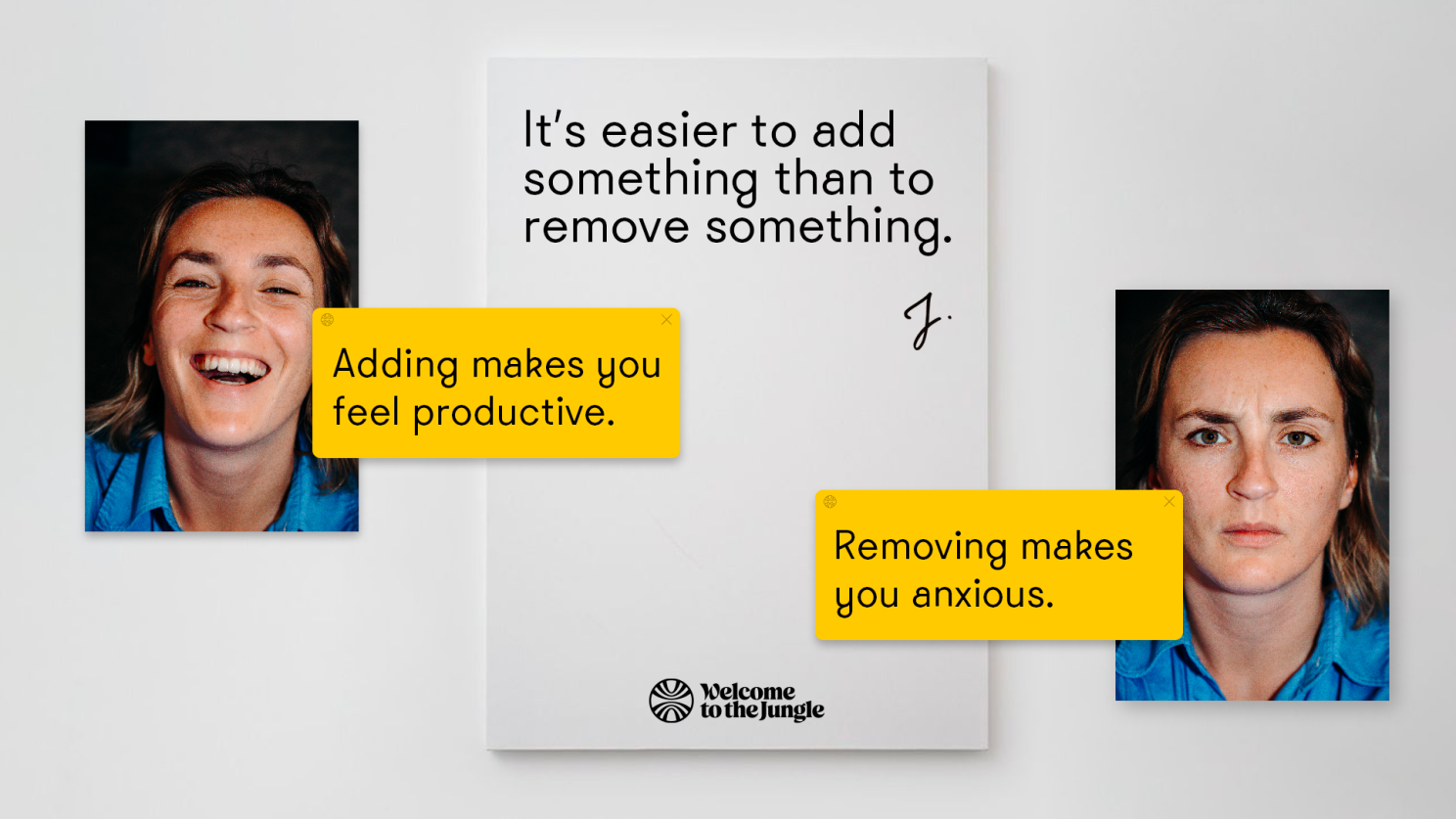
It's easier to add something than to remove something. Adding makes you feel productive. Removing makes you anxious. What if we need it later? Especially when you're in hypergrowth, like we were at Welcome to the Jungle, you're not thinking about simplification. You're thinking about filling holes. You're hiring fast, building fast, moving fast. But unfortunately, speed without simplicity is just chaos with better intentions.
The question I should have asked
Before, I was always asking this dumb question: how to do more with less? Now I know I should ask: how can we do the right things with the people we have?
Most companies ask the first option. Therefore they optimize and they try to squeeze more productivity out of people. They add more processes to make sure nothing falls through the cracks. I will try to focus on the second one, and focus on what actually matters. And try to say no to everything else.
That would require a different kind of discipline. Not the discipline of execution, but the discipline of elimination. It would require asking "Why?" constantly. Why are we doing this? Why are we doing it this way? Is there a simpler way? Hard questions, but very compelling ones.
What simple actually looks like
I’m convinced that the best products, strategies and company cultures are simple. They don’t need lengthy explanations and thousands of slides to be understood. They don’t need Google Slides (or Powerpoint, depending on how screwed you are in bureaucracy), Notion pages and a thousand OKRs.
Simple is powerful, memorable and what people actually want. It’s the hardest thing to reach because we, as individuals and companies, all have Diogenes syndrome in us waiting to pop up.

There is no magical solution. There is no framework to fix this because the problem isn’t a lack of frameworks, it’s an excess of them. It’s a fight to say “no” more often than you say “yes”, to prioritize building versus talking, to eliminate versus to accumulate. It’s worth it, because the companies that stay simple are the ones that stay alive.